
A Little DNA Goes A Long Way!
Updated: May 17
So sorry this post took so long to publish. I am also aware that I did not continue the story here, and I have not yet completed a full proofread. One advantage of writing this blog before turning it into a book is that it can be revised easily. As I identify grammatical errors or uncover new research, I can update the text promptly. Until today, the platform has been very easy to use.
The delay is largely due to a realization I had over the past several days: unlike a fictional drama, this account concerns real people. To avoid misrepresenting anyone, I reread approximately 300 pages of probate-court depositions twice to ensure that my descriptions align with the affidavits and testimony. These documents are public records, and I want my portrayal of the individuals and events to remain faithful to the historical record.
The Reason for My Obsession
Between 2015 and 2017, my sister began losing a significant amount of weight. She had been diagnosed with neuropathy and was caring for her husband, whose health had declined steadily since a liver transplant several years earlier. His condition required extensive caregiving. Their two children helped considerably; however, with young families of their own, the responsibility was necessarily shared.
During this period, my sister, Dana, appeared increasingly fatigued and seemed less able to enjoy life as she once had—an understandable outcome given the demands of caring for a bedbound spouse. Her husband, Roy, passed away in February 2018. In some ways it felt sudden; his condition deteriorated sharply near the end. The experience was surreal for all of us, and especially for Dana.
By early 2017, Roy was essentially bedbound and paralyzed from mid-chest down. Anyone who has served as a primary caregiver in such circumstances understands how relentless the work becomes. The level of care required can be as constant as caring for an infant, and it often deepens the bond between caregiver and loved one.
Even after Roy’s passing, Dana continued to feel unwell. I recall several occasions when it was evident she became exhausted far too quickly and far too often. She also had a notably high pain tolerance. If I remember correctly, she received no medication during her son’s birth and wanted to remain at home as long as possible. She delivered him just forty-five minutes after arriving at the hospital.
One example of her decline stands out. On Decoration/Homecoming Day at Union Grove Baptist Church in Big Gully, we held what I remember as a wonderful cookout. Although Dana had her grandchild and great-grandchild with her—children for whom she had essentially lived since their births—she left early because she felt unwell.
Eventually, she developed severe upper back and shoulder pain. Around the same time, her legs became increasingly “tingly,” and she appeared to lose mobility rapidly. Her neurologist requested a brain scan, which revealed a sizable lesion on her brain stem. Unfortunately, it was located in what one physician called a “high-rent district”—an area too dangerous to biopsy.
Naturally, cancer was the immediate concern, and she was referred to a radiation oncologist. Just before beginning treatment, the oncologist observed that anti-inflammatory medication appeared to have slowed the lesion’s growth and possibly reduced its size slightly. Because of that response, he referred us to an excellent neuro-oncologist at Vanderbilt University Hospital. Over multiple visits, we pursued a range of tests and treatments, including at least two spinal taps. None of the findings supported a diagnosis of brain-stem cancer, which, we were told, is typically very aggressive in adults.
After extensive testing to rule out other possibilities, the Vanderbilt neuro-oncologist reached a working diagnosis based on distinctive symptoms—one of which was mouth ulcers—and on Dana’s response (and lack of response) to treatment. His conclusion was Behçet’s disease with neurological involvement.
Before offering that opinion, he asked whether we had ancestry from regions associated with the “old Silk Road,” including the Iberian Peninsula, Turkey, India, the Middle East, and North Africa.
If you know me, you know I am fair-skinned and sunburn easily. I would not describe myself as pale, but I am certainly lighter than many. Since Behçet’s syndrome was first identified by a dermatologist, I mentioned it to mine. She would not have suggested I was anything other than a fair-skinned Caucasian. I rarely leave her office without having something removed—nothing serious so far, but the cumulative effects of sun exposure from farm work, surveying early in my career, and years of outdoor sports have left lasting damage.
Dana tanned more easily than I did, but we had never considered it significant. Our father often appeared dark-skinned with black hair, but we attributed that to long hours farming in the sun. In winter, his complexion lightened. Our mother also tanned well, but nothing about it seemed unusual.
Still, the questions from physicians became impossible to ignore. From our first visits with Vanderbilt specialists, through appointments with a neuro-immunologist, and even during Dana’s final days in the ICU, we were repeatedly asked the same question: Did we have Middle Eastern, Iberian, North African, or South Asian ancestry? For someone who needs answers, that repetition eventually becomes a call to investigate.
My mind returned to an interview I conducted in seventh or eighth grade with my grandmother “Doll” and our great-aunt Mae. My grandmother told me that her mother had “some Indian” ancestry and referred to herself as “Black Dutch.” At the time, I assumed this meant Native American ancestry and that “Black Dutch” was simply a label used in earlier generations when anyone perceived as non-white faced restrictions on land ownership, voting, and other rights. My grandmother’s brother—my great-uncle Louie—was always told that if anyone asked, he should say we were Black Dutch. His photograph is the cover image for this post.
My grandmother also told me that one of her grandmothers (my great-great-great-great-grandmother) was a Grindstaff before marriage. As I understood it then, “Grindstaff” might have been a misunderstanding of the German name “Cransdorff,” the kind of change that sometimes occurred during immigration. I even wondered whether “Black Dutch” was a mispronunciation of “Black Deutsch,” since Germany is “Deutschland.”
At that age, however, I did not think much about it. Grandparents were simply grandparents, and I had never paid attention to complexion or ancestry in any serious way. My early genealogy work relied mostly on published family histories. I was fortunate to find a detailed Rhyne genealogy compiled by a distant relative. One of Eli Johnson’s daughters married a Rhyne (see the “Be Fruitful and Multiply” post for a summary of that generation). That publication helped me organize the Johnson line, but as a busy high school student still needed on the farm, my research often ended at gravestones.
Later, once the internet became widely available, I searched the term “Black Dutch.” The first article I found was titled, “So, They Told You That You Were Black Dutch.” I expected to read about German immigrants.
I worked on genealogy periodically for years, but in 2004 I lost everything in a house fire, including all of my research. As an aside, there is a saying that you only receive in life what you give away. After the fire, that became real for me. People helped me rebuild in remarkable ways, even returning souvenirs I had given them from trips and meaningful experiences. In time, my aunt Lucy McKeehan—who purchased my grandmother Doll’s house—went through my grandmother’s belongings and returned the genealogy materials I had given her. My grandmother had wanted a copy of everything I completed, and in a sense, I received it all back. (I recognize that I can wander off topic.)
After 2004, I either saw—or finally noticed—a photograph of my uncle Louie. Once I did, I became convinced we had Cherokee ancestry. His nickname at work was “Chief.” From that point forward, I gave little thought to “Black Dutch” beyond assuming it referred to Cherokee heritage. I have since read several books on Cherokee DNA and will share that research in a later post.
Because of these two factors—my sister’s illness and our family’s “Black Dutch” tradition—I decided it was time to pursue genetic testing. I have purchased approximately twenty test kits and either used them myself or provided them to selected relatives who could help clarify lines I cannot test directly, such as a maternal line through mitochondrial DNA or a paternal line through Y-DNA.
For example, I cannot trace the Hill line precisely through Y-DNA unless one of my mother’s brothers (her maiden name was Hill) completes a Y-DNA test.
It is important to remember that the Y chromosome passes from father to son with remarkable consistency, aside from occasional mutations. While “mutation” can sound alarming, in this context it often refers to a small copying variation—similar to a minor error produced by a machine. These differences are called alleles. The useful aspect of such changes is that once they occur, they can be passed forward and help identify which relatives share a common ancestor. This will matter later in the story.
I could add several more paragraphs about how frequently medical professionals asked about our ancestry. One ICU physician, originally from Turkey, told us he had treated thousands of cases there early in his career but had not seen a case in the United States until my sister. He said, “Behçet’s syndrome is worse than cancer because it can attack any and every system of your body.”
Based on my research, there are approximately 20,000 new cases of Behçet’s disease each year in the United States, and only a small fraction involve neurological complications. It is rare enough that our Vanderbilt team told us they had never treated a case with neurological involvement and had only seen such cases presented at medical conferences.
To be clear, I do not claim deep expertise in genetics—there is far more I do not know than I do. However, I have worked to understand the fundamentals as they relate to ancestry. I have used 23andMe, Ancestry.com, FamilyTreeDNA, and CRI Genetics. Each has strengths and limitations, depending on what one is trying to learn.
As I understand it, the laboratory procedures are broadly similar across companies. The differences lie largely in the size and composition of their reference populations—the groups against which your DNA is compared.
A few additional points may be helpful for readers interested in the process. To trace a direct maternal line (mother to mother), mitochondrial DNA testing is used. To trace a direct paternal line (father to son), Y-DNA testing is used. Over time, mutations can occur, and those variations can help distinguish branches of a family line and identify shared ancestry.
With the technology now available, DNA testing has become an important part of genealogy. For me, it is also a way to investigate whether Dana—and possibly Kent, our nieces and nephews, and I—carry a genetic predisposition related to this rare disease.
Thank you for reading. I hope to share the next segment of the story within a week. Those chapters of our history are far more engaging. Please stay safe.
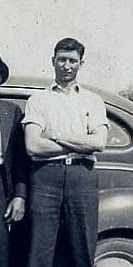
Thank you for these pictures Michele Johnson Atkins.
Once I saw this picture, I was sure that we were part Cherokee. Additionally, Uncle Louie’s nickname at work was Chief. After that I never gave much more thought to the Black Dutch other than to ASSUME that we were part Cherokee. I have now read several books about Cherokee DNA and will share that with you in a later post.
So again, because I cannot make a long story short apparently and because of these two pieces of information (my sister's genetic disease and our Black Dutch heritage), I decided that it was time to do some genetic testing. I have probably purchased 20 test kits at this point and took them or gave them to select relatives that can produce either a maternal lineage which I cannot on the X chromosome or a Y line that my DNA does not hold on the Y chromosome.
For example, I cannot trace the exact line on the Hill side of my family unless I get one of my mother’s brothers (My mother’s maiden name was Hill) to do a Y lineage test.
Keep in mind that the Y chromosome passes exactly from father to son except for a mutation that starts repeating every now and then. Once that happens, the Y line may have some mismatches. I was adamant about finding the source of our heritage. I think that I failed to mention that Behcet’s syndrome is an inherited condition and there is a specific gene that causes it (that phrase is a little strong). If you have the gene and the correct trigger, your body (as with some other autoimmune diseases) will attack every organ including your blood vessels.
I could write three more paragraphs about how many medical professionals asked us that same question about our heritage. This included a doctor in the ICU who said that he had treated thousands of cases in Turkey where he was from originally when he was first out of medical school but had not seen one case in the US until my sister. This is an exact quote from that ICU doctor. He stated, “Bechet’s syndrome is worse than cancer because it can attack any and every system of your body”.
Furthermore, based on my research, there are only 20,000 new cases of Behcet’s disease (20,000 new cases each year out of a population of about 328 million people) in the US and a very small fraction of those have neurological involvement. It is so rare that our team of doctors at Vanderbilt stated that they had never treated a case with neurological involvement before and never even seen one except maybe someone with the disease on stage being a part of a medical conference presentation.
Just please note, I do not know more about DNA than I know (propably 95 percent that i do not know). However, I have worked really hard to understand the basics as it applies to ancestry. I have used 23andMe, Ancestry.com, FamilyTree, and CRI genetics. They each have their own pros and cons. It depends on what one is looking for.
Each of these, I am told, basically use the same technical procedures on the DNA. Where they vary is in how many people groups from which the testing entity (i.e. Ancestry, 23andMe, Familytree, and CRI ) has a sample to compare your DNA.
A couple of more facts if one is looking for something specific in your DNA. If you want your maternal line which is all mothers typically for the last 5 generations, then you test your mitochondrial DNA. Since each father passes to his son an exact copy of his Y chromosome, your Y chromosome can show your lineage. However, periodically, there are mutations. A genetic mutation may sound like a big deal. However, it is just a small change in the Y DNA as just a slight bad copy as one might get on a copying machine from time to time. It may just malfunction a bit while being copied. These differences are called alleles. The helpful part of mutations is that once it occurs, it is past from father to son as an exact copy as well and thereby helps you determine which cousins with whom you have a common ancestor. I promise that all of this comes into play at a later date.
Below, I pulled an examplefrom FamilyTree just to show you how that an allele is recorded on their website.
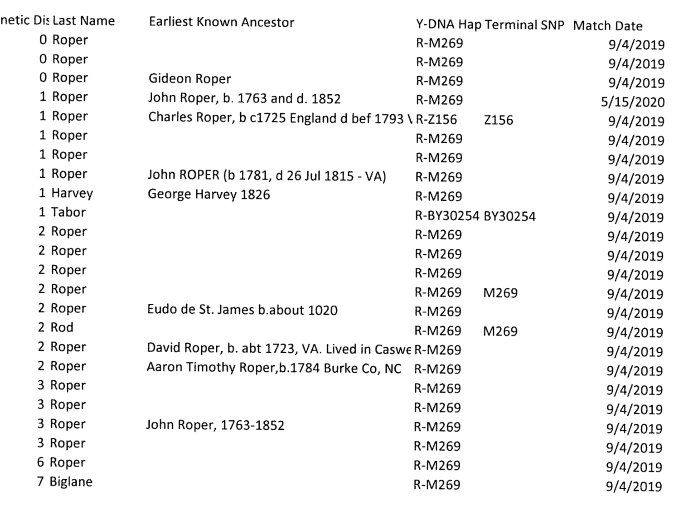
Sorry that this does not show up very well. But, the important part as it relates the above information is that whomever had their DNA tested on 67 points of their Y chromosome, have three matches above with zero alleles. Seven people have only one mutation on the Y chromosome. This means that 66 of the 67 points measured on the Y chromosome is an exact match to the test subject. Yes. I know, pretty boring!! Sorry but it becomes necessary as our story proceeds.
But, with the technology available a part of genealogy must include DNA testing and for me specifically. That is the manner in which I will determine where not only Dana but possibly, Kent, our nieces and nephews and I have the gene for this rare disease.
Thanks again for reading and I really hope to post the next segment of the story in no more than a week. I know those parts of our history are much more fun. Stay safe!

Comments